

For jewelry brands, one of the strongest appeals of baroque pearls is the sense of individuality they can give to a product. Consumers are not only buying a pearl earring or necklace; they can feel that the piece they receive has its own character because the natural form of each pearl is slightly different.
This can be especially valuable for brands whose customers are drawn to jewelry that feels personal, organic, artistic, or less mass-produced. Instead of competing through increasingly complicated designs, a brand can use the natural character of baroque pearls to make relatively simple pieces feel more distinctive.
That creates an interesting opportunity for collection development. The same design language can extend from earrings and necklaces to bracelets and rings, giving a brand a recognizable pearl collection without making every product look identical.
But turning that idea into a commercial collection requires more than selecting attractive pearls.
A jewelry brand still needs to decide what kinds of shapes belong in the collection, how much natural variation is acceptable, how pearls should be matched across different products, which metals and finishes support the intended positioning, and how those decisions can be reproduced during bulk production.
This is where the role of a baroque pearl jewelry manufacturer becomes important.
From our perspective at Yinyuan, the goal is not to eliminate the natural variation of baroque pearls. It is to define which variation belongs to your brand—and control it consistently enough to build a collection.
In this guide, we will look at how jewelry brands can turn baroque pearls into a complete custom collection, from brand positioning and pearl selection to earrings, necklaces, bracelets, rings, sampling, and bulk production.
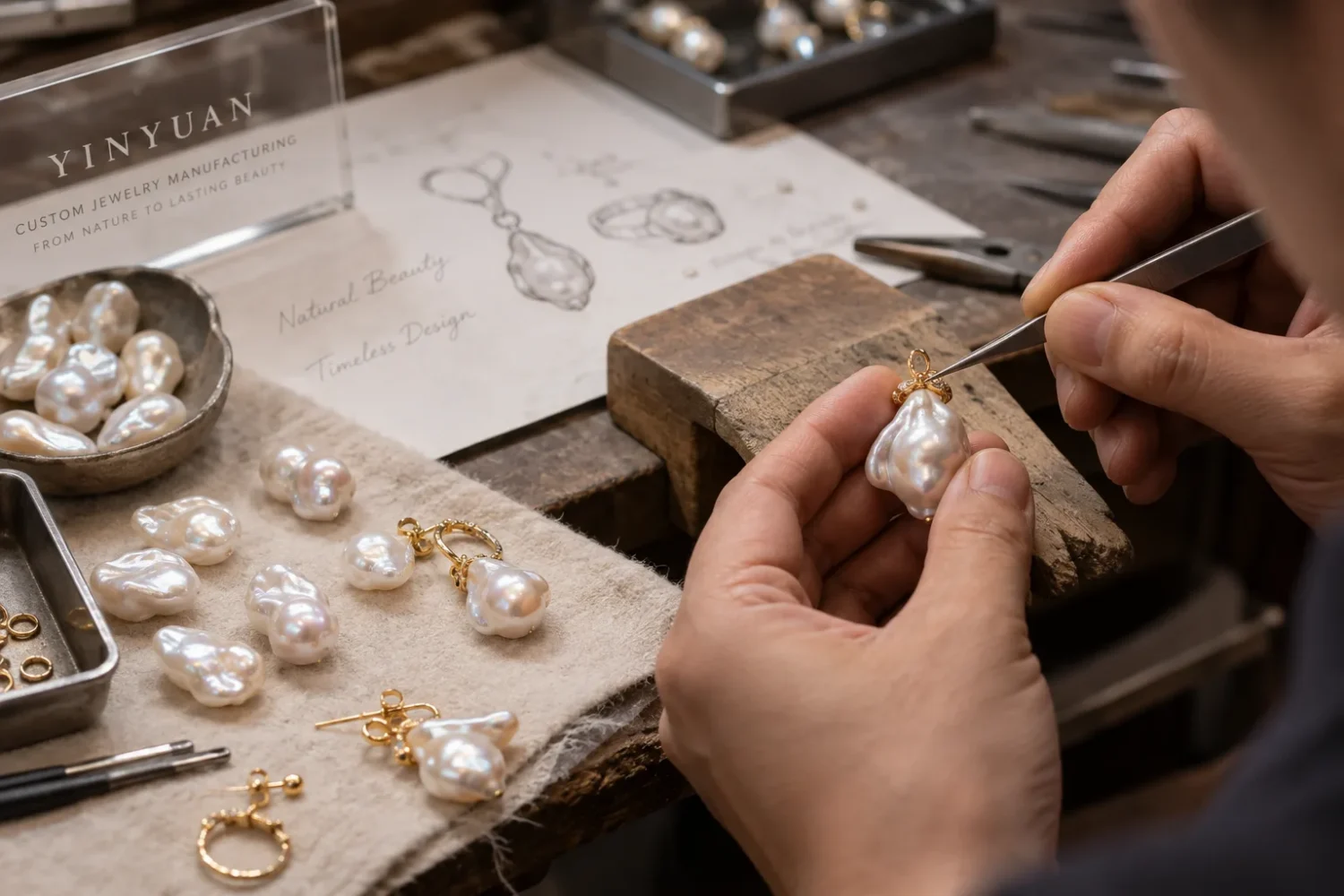
What Is a Baroque Pearl?
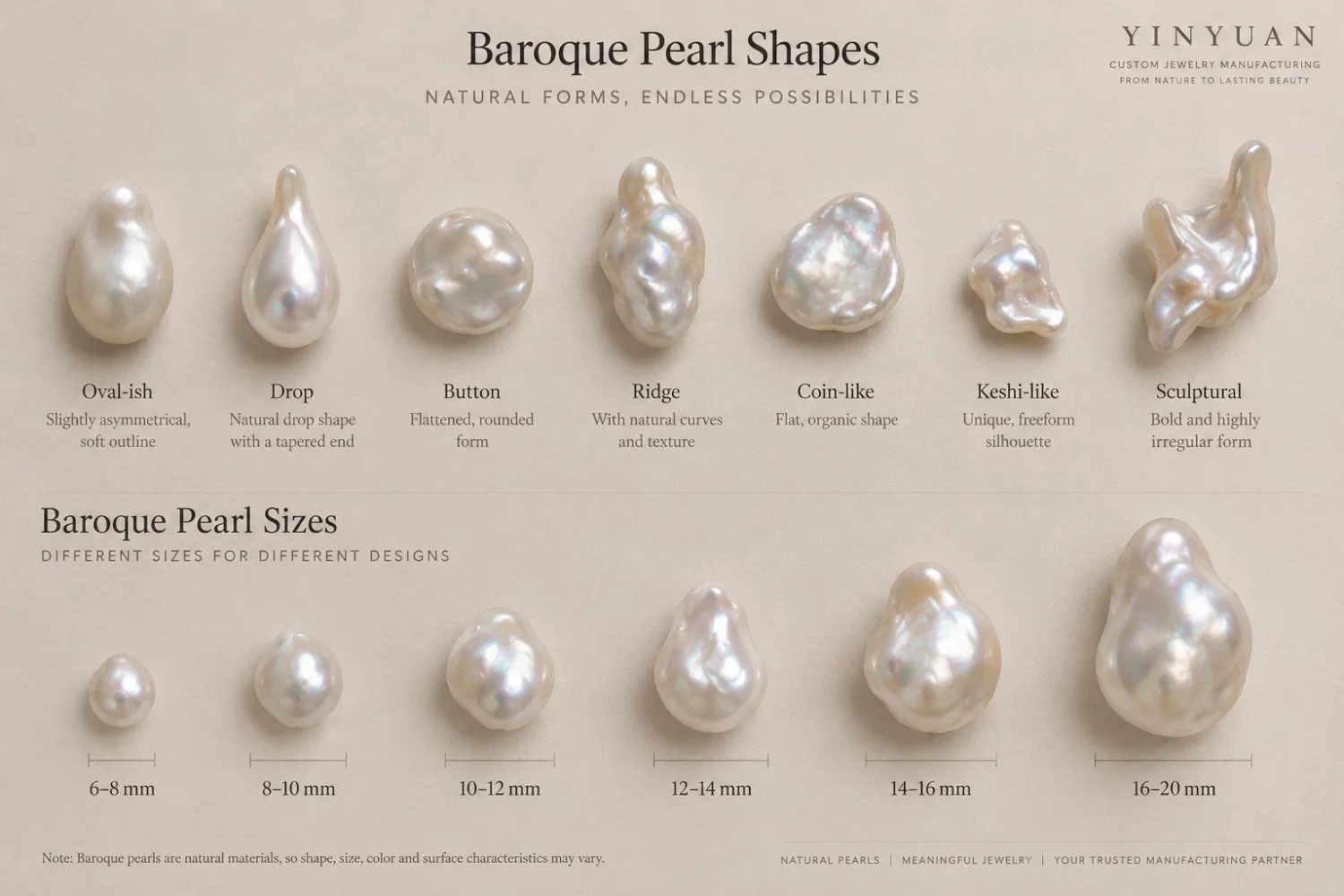
A baroque pearl is a pearl with an irregular, non-spherical shape. Some are only slightly asymmetrical, while others have highly organic forms with curves, ridges, flattened areas, or sculptural silhouettes.
The Gemological Institute of America (GIA) includes baroque among the principal pearl shapes and evaluates pearls using factors including size, shape, color, luster, surface quality, nacre quality, and matching.
These factors provide a useful technical language for evaluating pearls. For a jewelry brand, however, they are also design decisions.
Instead of treating every baroque pearl as an interchangeable component, brands can use differences in shape, proportion, luster, and surface character to define the visual direction of a collection. Some designs may call for a more controlled and refined pearl selection, while others can deliberately preserve stronger irregularities to create a more organic or artistic identity. For example, a long or drop-like baroque pearl may naturally suit an earring, while a flatter pearl might work better as the focal point of a pendant.
The question is therefore not simply whether a pearl is “good” or “bad.” It is whether its characteristics are appropriate for the product—and the brand language—you are developing.
What Can Baroque Pearls Bring to Your Brand?
Choosing baroque pearls should not be based only on the fact that they are different from round pearls. Materials contribute to the visual language of a jewelry brand. The way baroque pearls are selected and combined with metal, proportion, finish, and product structure can help a collection communicate a particular aesthetic.
1. Create a More Organic and Individual Design Language
Traditional round pearls naturally lend themselves to symmetry and visual uniformity.
Baroque pearls can move the design language in another direction. Their irregular forms can support collections that feel more organic, individual, artistic, or contemporary.
This can be particularly useful for brands that do not want pearl jewelry to feel overly traditional. The pearl itself becomes part of the design rather than simply a standardized component added to it.
2. Make Simple Jewelry Designs More Distinctive
A distinctive product does not always require complicated construction.
Consider a clean gold vermeil hoop with one carefully selected baroque pearl. The metal structure can remain minimal while the pearl provides the focal point. The same principle can work with a simple chain necklace or a slim ring.
For brands developing minimalist jewelry, this creates an interesting strategy: simple structure + distinctive natural element. Instead of adding more components to make a design recognizable, the natural form of the pearl can carry part of the visual identity.
3. Build a Recognizable Look Across a Full Collection
A collection does not require every SKU to use an identical pearl.
In fact, forcing identical shapes across baroque pearl jewelry can work against the material itself.
A better collection system might define common characteristics such as:
a similar pearl color range; a consistent level of luster; an approved family of organic shapes; related pearl proportions; the same metal color; and
recurring design details.
An earring, necklace, bracelet, and ring can then look different while still clearly belonging to the same collection.
This is where baroque pearls become particularly interesting from a product-development perspective: natural variation can create individuality between SKUs without losing the broader collection identity.
4. Match Baroque Pearls to Different Brand Positions
Baroque pearls do not automatically make a jewelry brand premium, artistic, or contemporary.
They are a design language, not a brand position by themselves.
Their effect depends on how they are used.
A minimal contemporary collection might use a single irregular pearl with a clean metal structure. A romantic collection might use softer drop shapes with delicate chains. A designer-led collection could deliberately emphasize highly sculptural pearls and asymmetrical compositions.
For a more refined positioning, a brand might specify tighter ranges for luster, surface quality, shape, and color and combine them with gold vermeil or solid gold.
The same material can therefore support very different products.
The important question is not:
“Are baroque pearls right for my brand?”
It is:
“What type of baroque pearl, design, material, and finish expresses the position I want this collection to occupy?”
Define the Direction of Your Baroque Pearl Jewelry Collection
Before contacting a manufacturer with individual product ideas, define the collection at a higher level.
This makes sourcing, design development, sampling, and costing much more efficient.
1. Identify Your Target Customer and Price Position
Start with the customer.
Is the collection intended to be accessible fashion jewelry, contemporary sterling silver jewelry, premium vermeil, or fine jewelry?
This decision influences almost everything that follows:
- pearl selection;
- base metal;
- plating specification;
- construction;
- stone or pearl size;
- packaging;
- target production cost.
A beautiful design that cannot meet the intended retail price is not yet a commercially workable product.
Giving your manufacturer a target positioning or price range can therefore be more useful than simply asking for “the best pearl.”
2. Decide the Visual Language of the Collection
Before choosing individual pearls, define what kind of irregularity you actually want.
Should the collection feel soft and feminine? Raw and organic? Minimal? Sculptural? Refined?
Reference images, sketches, mood boards, and existing brand products can help communicate this.
This gives the manufacturer a better basis for sourcing and sorting pearls that fit the design direction.
3. Plan Your Product Categories and Number of SKUs
Next, decide how the collection will be structured.
For example:
3–4 earring designs;
2 necklace designs;
2 bracelet designs;
1–2 rings.
This does not mean every category needs to launch at once.
For a smaller brand, starting with a focused group of hero products may make more sense than spreading the initial order across too many SKUs.
The important point is to think in terms of a collection architecture, rather than developing unrelated products one at a time.
Choose the Right Baroque Pearls for Your Collection
Once the collection direction is clear, pearl selection becomes much more specific.
1. Pearl Shape
“Baroque” covers a broad range of irregular forms.
Some pearls are elongated. Some are flatter. Others are rounded but asymmetrical, while some are highly sculptural.
Instead of specifying only “baroque pearl,” use references or approved samples to communicate the family of shapes you want.
This becomes especially important when a design is repeated in bulk.
2. Pearl Size
Pearl size changes more than the visual appearance of a piece.
It affects proportion, weight, setting construction, and potentially cost.
A pearl that works beautifully as a necklace focal point may feel too large for an everyday earring. A smaller pearl that works on a delicate bracelet might not have enough visual presence for a statement ring.
Size should therefore be selected in relation to the product rather than across the collection in isolation.
3. Luster, Color and Surface Characteristics
Luster, body color, overtone, and surface characteristics can change the overall impression of a collection.
These factors should be discussed during development rather than left until final inspection.
For example, if the approved samples use bright, high-luster pearls with a relatively clean appearance, a bulk batch with noticeably duller pearls can change the perceived quality of the product even if the dimensions remain correct.
4. Define an Acceptable Range of Natural Variation
This is one of the most important steps when working with baroque pearls.
A manufacturer needs to know what can vary and what cannot.
Your approved range might cover:
- minimum and maximum pearl dimensions;
- acceptable shapes;
- color range;
- luster expectations;
- surface characteristics;
- orientation in the finished jewelry.
This transforms a subjective instruction such as “make them look similar” into something that can actually be used during production and QC.
Build Your Baroque Pearl Product Mix
With the pearl direction established, the next step is deciding how the material should behave across different jewelry categories.
Each product has different structural and aesthetic requirements.
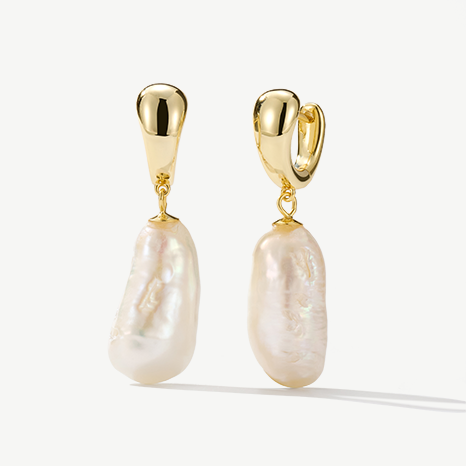
1. Custom Baroque Pearl Earrings
Earrings are one of the clearest examples of why matching matters.
For a pair of earrings, two pearls do not necessarily need to be identical. They do, however, need to look intentional together.
A baroque pearl earrings manufacturer should consider factors such as:
- visual size;
- overall silhouette;
- color;
- luster;
- weight;
- orientation.
For symmetrical designs, tighter pair matching may be appropriate.
For intentionally asymmetrical earrings, the manufacturer still needs a matching rule—the difference between the two pearls should feel designed rather than accidental.
Construction is equally important. Drop earrings, hoops, studs, and mounted pearl designs place different demands on drilling, attachment, balance, and weight.
2. Custom Baroque Pearl Necklaces
Necklaces provide more flexibility in how baroque pearls can be used.
A collection might include:
- a single-pearl pendant;
- a station necklace;
- a multi-pearl chain design;
- a strand;
- a layered necklace.
For a pendant, one distinctive pearl can become the centerpiece.
For a multi-pearl necklace, the relationship between the pearls becomes more important. They may be intentionally graduated, closely matched, or deliberately mixed according to the design.
The manufacturer therefore needs to understand whether the goal is uniformity, controlled variation, or deliberate contrast.
3. Custom Baroque Pearl Bracelets
Bracelets introduce additional durability and sizing considerations.
Baroque pearls can be incorporated into chain bracelets, station designs, strands, or pearl-and-charm combinations.
Because bracelets experience frequent movement and contact during wear, attachment methods and overall construction need particular attention.
When developing a custom bracelet collection, brands should consider not only how the pearls look but also how the bracelet sits on the wrist, how the pearls move, and how the clasp and connecting components perform.
For more on evaluating production capability in this category, see our guide on what to look for in a bracelet manufacturer.
4. Custom Baroque Pearl Rings
A baroque pearl ring needs to balance visual impact with wearability.
Large sculptural pearls can make strong statement pieces, but their height, orientation, and attachment need to be considered carefully.
During development, pay attention to:
- pearl proportion relative to the ring;
- profile height;
- mounting structure;
- attachment security;
- surrounding metal protection;
- comfort during wear.
The most visually unusual pearl is not automatically the best pearl for a ring. The final choice needs to work with the structure of the product.
Choose the Right Metal and Finish for Your Collection
Once the product mix is established, metal and finish help define both the aesthetic and commercial position of the collection.
1. 925 Sterling Silver
Sterling silver can work well for brands seeking a precious-metal base while maintaining a more accessible price point than solid gold.
Its neutral color also allows the natural color and luster of the pearl to remain visually prominent.
2. Gold Vermeil
Gold vermeil can give a pearl collection a warmer appearance while retaining sterling silver as the base metal.
However, the term alone is not enough when developing a commercial product. Brands should confirm the actual base material, plating specification, color, and quality-control method with their supplier.
If this is the direction of your collection, our gold vermeil jewelry manufacturer guide explains the manufacturing considerations in more detail.
3. Gold-Plated Jewelry
Gold plating can support different commercial price positions depending on the base metal and plating specification.
Brands should define the target color and plating requirements during sampling so the metal finish remains consistent across earrings, necklaces, bracelets, and rings.
4. Solid Gold
Solid gold can be appropriate for higher-value collections, particularly when paired with carefully selected pearls.
However, material choice should always be considered together with target retail price, design structure, pearl quality, and expected order quantity.
The most expensive material is not automatically the right material for every brand.
Turn Your Collection Ideas Into Production-Ready Designs
Once the product direction, pearls, and materials are defined, the collection needs to move from concept into manufacturing.
1. Prepare Your Design Brief and References
A useful design brief can include:
- sketches or reference images;
- target dimensions;
- preferred pearl shapes and sizes;
- base metal;
- finish or plating color;
- logo requirements;
- target quantity;
- target market or price positioning.
The more clearly the collection direction is communicated, the easier it becomes to identify technical issues before sampling.
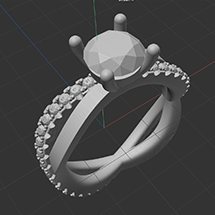
2. Develop CAD Drawings and Product Specifications
For custom metal components, CAD can help translate the design into manufacturable dimensions and structures.
This is where details such as wall thickness, attachment points, stone settings, pearl orientation, and component proportions can be reviewed.
Not every baroque pearl design can be treated as though the natural component has a perfectly standardized geometry. The metal structure may need to accommodate a defined range of pearl dimensions rather than one exact shape.
A manufacturer with custom jewelry manufacturing capabilities can help bridge the gap between the original design idea and production requirements.
3. Create and Review Samples Before Production
Sampling is particularly important for baroque pearl jewelry.
A drawing cannot fully communicate how a natural pearl will interact with the finished metal structure.
During sample review, look at:
- pearl proportion;
- orientation;
- color;
- luster;
- attachment;
- overall weight;
- wearing comfort;
- metal finish;
- product dimensions.
The approved sample can then become an important reference for bulk production.
Plan MOQ, Sampling, Lead Time and Bulk Production
A product can be beautiful and technically manufacturable but still be difficult to launch if the production plan does not fit the business.
This is why MOQ, sampling, and lead time should be discussed before the collection is finalized.
1. Understand How MOQ Works Across Multiple SKUs
If your collection contains four earrings, three necklaces, two bracelets, and two rings, do not ask only:
“What is your MOQ?”
Ask how the MOQ applies.
Is it calculated per design? Per color? Per plating finish? Per ring size? Or can quantities be distributed across part of the collection?
These details can significantly affect how many SKUs a new collection can support.
2. Plan Sampling Before Committing to Bulk Production
Sampling allows the brand and manufacturer to validate both aesthetics and construction.
For a baroque pearl collection, it also helps establish the expected pearl range.
Changes are much easier to make at this stage than after hundreds of pieces have entered production.
3. Prepare for Repeat Orders and Collection Expansion
Think beyond the first production run.
If a design performs well, can it be reproduced with a similar pearl specification six months later?
Can a hero earring design be extended into a necklace or bracelet?
Can the same collection language support a new color or finish?
A good collection is not just manufacturable once. Ideally, it has enough structure to be repeated and expanded.
What to Ask a Baroque Pearl Jewelry Manufacturer Before Production
By this stage, the role of the manufacturer should be clearer.
You are not simply looking for a company that can purchase pearls and attach them to metal components. You need a production partner capable of translating natural variation into repeatable products.
Before placing an order, consider asking the following questions.
Can They Source Pearls to Your Specifications?
Ask whether pearl sourcing can follow defined requirements for size, shape, color, luster, and overall appearance.
If your collection depends on a very specific type of irregular shape, provide visual references during sourcing.
Can They Develop a Complete Jewelry Collection?
A manufacturer producing one pearl pendant is not necessarily equipped to develop an integrated collection.
If you plan to produce earrings, necklaces, bracelets, and rings, confirm that the manufacturer can manage the different structural requirements across those categories.
How Do They Control Natural Pearl Variation?
Ask how pearls are sorted and matched before production.
For earrings, ask specifically how pairs are selected.
The answer should help you understand whether the supplier has a practical system for handling natural materials rather than simply promising that “all pearls will look the same.”
What Sampling and Quality Control Process Do They Use?
Ask how designs move from CAD or reference images into samples and bulk production.
Also clarify what is checked before shipment.
If you are still evaluating potential partners, our guide to choosing a custom jewelry manufacturer covers additional factors including product development, MOQ, quality control, and supplier reliability.
Can They Maintain Consistency for Repeat Orders?
This matters if you are building a long-term product line rather than a one-season experiment.
Ask how approved specifications are recorded and how future pearl batches are selected against previous production standards.
Natural materials will always vary, but the selection logic should remain consistent.
Build Your Custom Baroque Pearl Jewelry Collection With Yinyuan
Developing a baroque pearl collection requires a careful balance between two priorities: preserving the natural character of each pearl and maintaining consistency across production.
Brands and manufacturers need to establish that balance during product development rather than wait until final inspection.
At Yinyuan, we work with jewelry brands, designers, wholesalers, and retailers to turn collection ideas into production-ready jewelry. Our team supports the development process from initial concepts and CAD design to sampling and bulk production.
Depending on your collection, our team can help source pearls and gemstones, select suitable metals and finishes, develop custom components, and manage stone setting, polishing, plating, assembly, and quality control.
More importantly, we encourage brands to consider the natural characteristics of baroque pearls from the beginning of the design process.
Instead of choosing a finished design first and adding a baroque pearl simply because it looks interesting, consider how the pearl itself can shape the design. Its size, form, orientation, luster, and natural variation can influence the proportions, structure, and visual character of each piece.
The same thinking can guide the wider collection. By defining a clear pearl direction and carrying consistent design elements across different products, you can turn one natural material into a recognizable family of earrings, necklaces, bracelets, and rings.
If you already have a baroque pearl collection in mind, share your sketches, reference images, preferred materials, target pearl direction, and expected quantity with Yinyuan. Our team can help you evaluate the concept, develop samples, and plan your custom jewelry manufacturing process.
Frequently Asked Questions
What should I look for in a baroque pearl jewelry manufacturer?
Look beyond whether a manufacturer can simply source baroque pearls. Check how the team defines pearl specifications, sorts and matches natural pearls, develops custom metal components, creates samples, manages quality control, and maintains approved standards for repeat orders.
If you plan to develop a full collection, choose a manufacturer that can also handle the different production requirements of earrings, necklaces, bracelets, and rings.
Can a manufacturer match baroque pearls for earrings and jewelry sets?
Yes. However, matching baroque pearls does not mean making every pearl look identical.
A manufacturer can sort pearls within an agreed range of size, shape, color, luster, and overall visual character. Earrings usually require closer pair matching, while necklaces, bracelets, or intentionally organic designs can allow more natural variation.
The key is to agree on how much variation fits the collection before bulk production begins.
What metals work well with baroque pearl jewelry?
Jewelry brands can pair baroque pearls with 925 sterling silver, gold vermeil, gold-plated metals, or solid gold.
Choose the metal according to your collection design, target customer, price positioning, durability requirements, and desired finish. For example, sterling silver can support a contemporary and accessible collection, while gold vermeil or solid gold can help create a different price and design position.
Can I manufacture a full collection of baroque pearl earrings, necklaces, bracelets and rings?
Yes. Developing several product categories together can help your brand create a more consistent collection language.
However, your manufacturer should develop each category according to its own technical requirements. Earrings need careful attention to weight and pearl pairing, bracelets need secure construction for frequent movement, and rings require careful consideration of pearl proportion, height, attachment, and wearability.
The collection should share one visual direction without forcing every product to use the same construction.
What information should I send a manufacturer before requesting a quote?
Send your manufacturer as much relevant product information as possible. This may include sketches or reference images, preferred pearl size and appearance, materials, plating requirements, dimensions, logo details, quantities for each design, and your target delivery schedule.
If you have not finalized every specification, share your target customer, price position, and overall collection direction as well. A manufacturer with product-development capabilities can then help you identify the remaining decisions before sampling and quotation.
