

Gold vermeil and gold plated are two common options for creating gold-finish jewelry, but the differences between them go beyond appearance. Each option uses a different material structure and follows different requirements for the gold layer, which can affect production cost and collection positioning.
For jewelry brands, wholesalers, and designers, understanding these differences helps you decide how to develop a new product or collection. Your choice needs to fit the design, target price, material strategy, and the product you ultimately want to bring to market.
This guide compares gold vermeil vs gold plated jewelry from both a product and manufacturing perspective. You’ll learn how the two options differ, when each may fit your collection, what information to give your manufacturer before sampling, and which specifications to confirm before bulk production.
Gold Vermeil vs Gold Plated: What’s the Difference?
The biggest difference is the construction underneath the gold finish. Gold vermeil has a sterling silver base and, under U.S. guidance, a defined minimum standard for its gold coating. Gold plated jewelry can use different base metals and plating specifications, giving brands more options when developing products at different price points.
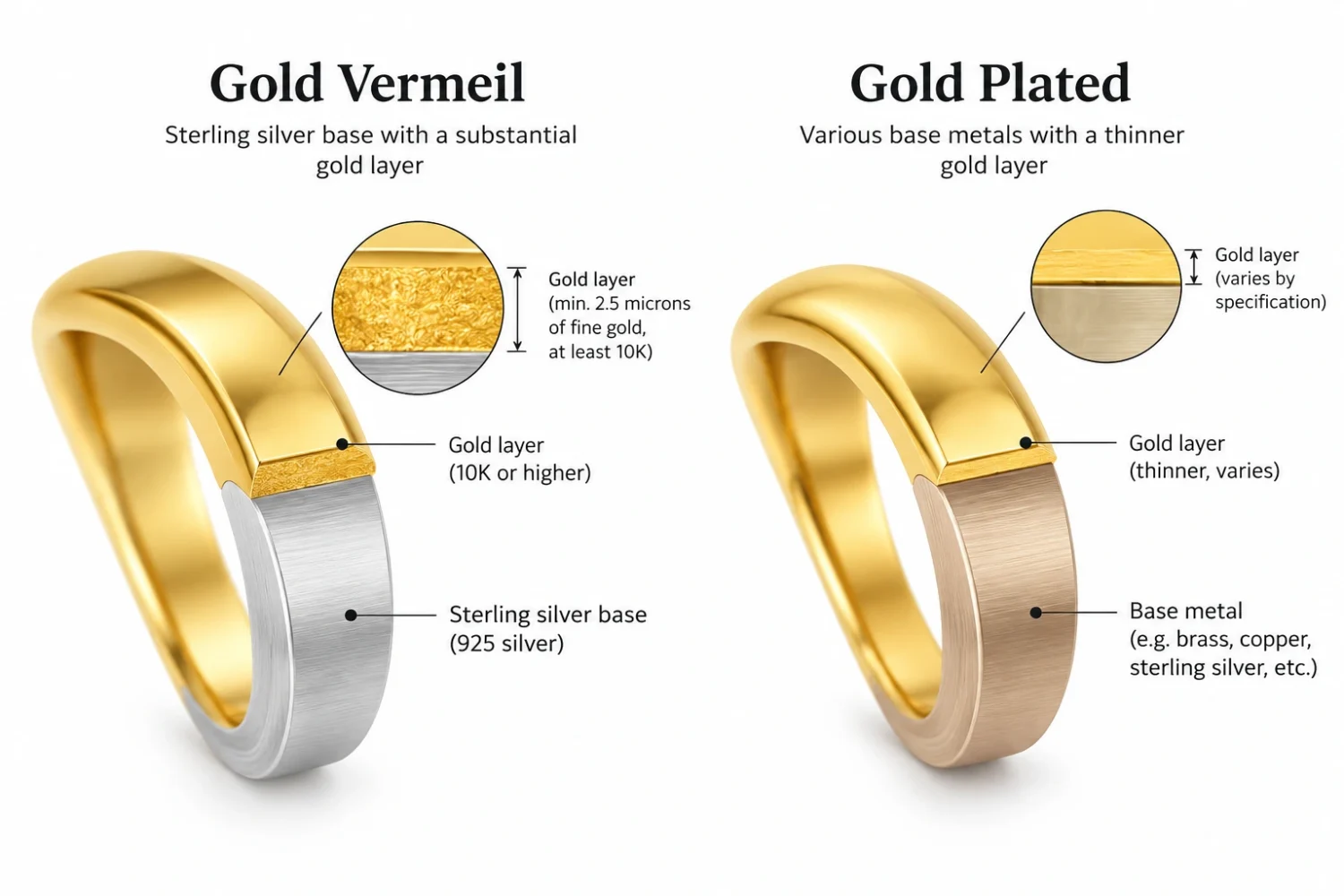
Here is how the two compare:
| Gold Vermeil | Gold Plated | |
|---|---|---|
| Base Metal | Sterling silver | Can include sterling silver, brass, or other suitable jewelry metals |
| Gold Purity | At least 10K under the U.S. vermeil definition | Depends on the specified finish, such as 14K or 18K gold plating |
| Gold Thickness | At least 2.5 microns equivalent of fine gold under the U.S. vermeil definition | Varies according to the plating specification |
| Material Cost | Usually higher because of the sterling silver base and defined gold-layer requirement | Can be lower depending on the base metal and plating specification |
| Product Positioning | Commonly suited to sterling silver and demi-fine collections | Can cover a wider range of fashion, accessible, and sterling silver jewelry |
| Development Flexibility | Sterling silver base is required for the vermeil designation | Brands have more flexibility in choosing the base metal and plating specification |
| Best Fit for Brands | Brands that want a gold-finish collection built on sterling silver | Brands that need more flexibility around target cost, base material, or product positioning |
Under the U.S. 16 CFR § 23.4 standard for vermeil, vermeil must use a sterling silver base. Gold or gold alloy of at least 10 karat fineness must cover all significant surfaces, with a minimum thickness throughout equivalent to 2.5 microns of fine gold.
This standard gives brands a clear material benchmark when sourcing vermeil products. For example, a brass product with a thick gold coating would not qualify as vermeil under this U.S. definition because it does not use sterling silver as its base.
Gold plated jewelry works differently. The term itself does not tell your manufacturer which base metal to use or which plating specification you expect.
For example, two suppliers may both quote an “18K gold plated” necklace. One may use sterling silver and the other brass. They may also offer different plating thicknesses. The quotations may look similar at first, yet they do not necessarily describe the same product specification.
What Is Gold Vermeil?
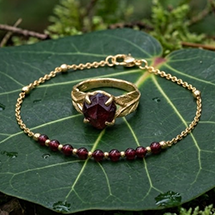
Gold vermeil combines a sterling silver base with a gold coating that meets specific requirements.
The sterling silver foundation forms an essential part of the product. This material structure separates vermeil from gold-finish jewelry that uses brass or another base metal underneath the plating.
For brands already developing sterling silver collections, gold vermeil jewelry provides a way to introduce a gold finish without changing the underlying precious-metal category.
For example, you may already sell a necklace collection in rhodium-plated sterling silver. You could develop selected designs in gold vermeil to add a gold color option and retain sterling silver underneath both versions.
This approach can also keep the material story consistent across a collection. Your customers can choose between silver and gold finishes, and both versions still use sterling silver underneath.
What Is Gold Plated Jewelry?
Gold plated jewelry uses a layer of gold over another metal. Depending on the product and manufacturing brief, brands may choose sterling silver, brass, or another suitable jewelry metal as the base.
This gives you greater flexibility in how you structure a collection.
You might choose sterling silver when the underlying precious metal supports your product positioning. If your collection needs to reach a different target cost, another suitable base metal may fit the product plan better.
The term “gold plated,” however, does not provide enough information to define the finished product.
Two products described as 18K gold plated may share a similar gold appearance yet use different base metals, plating thicknesses, and production specifications.
The FTC guidance on gold-plated jewelry explains that gold plating wears over time. Plating thickness and how customers wear the jewelry both influence how the finish wears.
This matters when you compare suppliers.
If Supplier A and Supplier B both quote “18K gold plated,” do not assume they have quoted the same product. Ask each supplier which base metal they use and what plating specification the quotation includes.
Gold Vermeil vs Gold Plated: Which Fits Your Jewelry Collection?
The decision becomes clearer when you start with the collection rather than the finish.
Consider a brand developing sterling silver necklaces, earrings, bracelets, and rings. If 925 sterling silver already forms the material foundation of the collection, vermeil provides a logical route for introducing gold-finish versions.
This is especially relevant when sterling silver itself forms part of the product positioning.
Brands developing this type of collection may therefore work with a sterling silver jewelry manufacturer that can manage the underlying silver product and its final surface finish as part of the same development process.
Gold plated jewelry provides greater flexibility around the underlying material.
A collection with a tighter target cost or a fashion-jewelry positioning may use another base metal and define the gold finish according to its product requirements. This gives the brand more room to balance design, material choice, production cost, and intended retail positioning.
Product type also deserves consideration.
Rings, bracelets, necklaces, and earrings experience different levels and types of contact during wear. Their structures, moving parts, exposed surfaces, and friction areas are different.
A finish specification that works for one design therefore should not automatically become the standard for every SKU in a collection.
Why “18K Gold Plated” Is Not a Complete Manufacturing Specification
A brand may send a manufacturer a product drawing with one simple finish requirement:
“18K gold plated.”
That tells the factory the general finish direction, but it leaves several important production details unclear.
What is the base metal?
Sterling silver and brass create different material structures, costs, and product positioning. Your manufacturer needs this information before providing an accurate quotation and production specification.
What plating thickness or requirement do you expect?
“18K” tells the manufacturer about the gold fineness or color direction. It does not tell the factory how much gold coating the product requires.
This distinction becomes particularly important when you compare quotations from different suppliers. A lower quotation may reflect a different base metal or plating specification rather than simply a lower manufacturing price.
Which 18K gold color do you want?
Two gold finishes can both fall under an 18K description and still show visible color differences.
Instead of relying only on the words “18K gold,” give your manufacturer a physical reference, approved sample, or agreed color standard whenever color consistency matters to your collection.
What surface finish does the design require?
High polish, matte, brushed, hammered, and textured surfaces create different visual results.
The factory first needs to prepare the underlying surface correctly before applying the final gold finish. For this reason, surface treatment forms part of the product specification rather than a separate cosmetic decision at the end.
Where will the product experience the most wear?
A ring shank, bracelet link, clasp, chain, and pendant surface experience different types of contact during use.
Discuss the actual product structure with your manufacturer instead of choosing a finish specification based only on the product category name.
Does your target market require testing?
If your target market or customer requires specific testing, discuss those requirements before production. Your manufacturer can then account for them during product development rather than trying to address them after you approve the design.
When you work with a jewelry factory, these details turn a general design request into a production specification that the workshop can follow.
This level of detail becomes particularly important when you move from one sample into hundreds or thousands of pieces.
“Gold plated” describes the finish category. A production specification defines the product.
What Should Jewelry Brands Confirm Before Sampling?
Before sampling begins, the brand and manufacturer should establish the main material and finish requirements for the product.
The base metal needs to be confirmed first because it establishes the foundation of the piece.
The gold purity or color and plating requirement then define the intended surface finish. Surface treatment, dimensions, construction details, and applicable testing requirements also need to match the actual design.
The product itself matters here.
A delicate pendant presents different manufacturing considerations from a chain bracelet with multiple moving links. A ring has significant regular contact with the hand and surrounding surfaces. Earrings have their own construction and wear conditions.
For this reason, specifications are more useful when they are developed around the actual product instead of copied automatically across an entire collection.
Once those requirements are clear, the manufacturer has a much stronger brief for producing the first sample.
The Approved Sample Should Become a Production Standard
Sample approval is more than deciding whether the jewelry looks right.
The sample is where the design, materials, finish, and manufacturing specification become a physical product.
At this stage, the brand can evaluate gold color, surface finish, dimensions, proportions, construction, and overall appearance at actual scale.
Any necessary adjustment should then be reflected in the final production requirements.
The approved sample gives both the brand and the production team a common reference before bulk production begins.
This also becomes useful for repeat orders.
A successful collection may return for another production run several months later. Clear specifications and an approved reference provide a much stronger basis for reproducing the product than a general description such as “18K gold plated.”
For brands building collections across multiple seasons, this consistency becomes part of supplier management.
Gold Vermeil or Gold Plated: Which Should Your Brand Choose?
Gold vermeil is worth considering when sterling silver is central to the product.
It fits collections that use sterling silver as their material foundation and want to introduce a gold-finish option without moving away from that base metal. This makes it particularly relevant to many sterling silver and demi-fine collections.
Gold plated jewelry makes sense when the product requires greater flexibility around base material, production cost, or market positioning.
That flexibility can be useful for fashion-focused collections, more price-sensitive product lines, or designs where different material options are being evaluated during development.
The choice should therefore begin with four questions:
What material should the product be made from?
Where does the product sit within the collection?
What target cost and retail positioning does the brand need?
What manufacturing specification will be used to achieve the approved finish?
From there, the process becomes much clearer:
Choose the material structure → define the finish → produce the sample → approve the production standard.
The right option is the one that matches the product your brand intends to manufacture and sell.
Developing a Gold-Finish Jewelry Collection
Gold vermeil vs gold plated is ultimately a product-development decision.
The selected finish needs to work with the base material, product design, target cost, positioning, and production requirements.
At Yinyuan, we have over 15 years of jewelry manufacturing experience. Our development process takes the complete product into account, from material and design specifications through sampling and bulk production.
Brands and wholesalers still exploring their collection direction can review our existing jewelry products for different product and design options. For projects specifically built around sterling silver with a gold finish, our gold vermeil jewelry manufacturing capabilities support custom collection development from sampling through production.
The goal is to establish a clear product standard before bulk production begins, giving both the customer and production team the same approved reference to work from.
FAQ
Is gold vermeil better than gold plated jewelry?
Not for every product. Gold vermeil uses sterling silver as its base and follows defined requirements for the gold coating, making it a strong option for sterling silver and demi-fine collections. Gold plated jewelry provides greater flexibility around base metals and production specifications. The right choice depends on the product and collection strategy.
Is gold vermeil real gold?
Gold vermeil uses real gold or gold alloy as its surface coating. It is not solid gold because the underlying product is made from sterling silver.
How thick does gold need to be for vermeil?
Under the FTC Jewelry Guides, vermeil uses a sterling silver base with gold or gold alloy of at least 10 karats on significant surfaces and a minimum thickness equivalent to 2.5 microns of fine gold.
Does gold vermeil last longer than gold plated jewelry?
The finish name alone cannot provide a reliable lifespan. Wear is affected by the plating specification, product type, frequency of wear, friction, exposure, and care. Comparing the actual specifications provides more useful information than relying only on the terms “vermeil” and “gold plated.”
What should a jewelry brand tell a manufacturer when ordering gold-plated jewelry?
Provide the base metal, desired gold purity or color, plating requirements, surface finish, product design, target market, and any applicable testing requirements. These details can then be evaluated through sampling before the final specification is approved for bulk production.
